
Islamic terror threat | Durham greenway stabbing near homeless encampment? | For-profit landlords abuse non-profit tax loophole
No. 167 — Mar. 8-Mar. 14, 2026
In Durham, a man was found fatally stabbed in yet another incident in a particularly crime-ridden part of the American Tobacco Trail, which is frequented by the homeless and has been noted as a danger by community members for decades.
A property tax loophole intended for affordable housing non-profits is being “abused” by for-profit landlords, potentially costing tens of millions in tax revenue for counties with high rates of usage such as Durham and Wake, leaving the county leadership potentially facing with the unenviable choice of cutting spending or increasing the taxation on the remaining non-exempt property owners.
With the recent cluster of Islamic terrorist attacks on American soil, we take a moment to reflect on the history and characteristics of parallel incidents involving individuals and institutions in the counties of Durham, Johnston, Orange, and Wake.
Man fatally stabbed on section of Durham greenway known for homeless, violence
Police: Deadly stabbing on American Tobacco Trail was not random, no arrest yet - WRAL
Man identified after fatal stabbing on American Tobacco Trail - ABC11
Person killed in American Tobacco Trail stabbing named, Durham police say it was not a random attack - CBS17
American Tobacco Trail stabbing was not random, but Durham police still need help - N&O
Chesleigh Lyons, 51, was found stabbed to death on the American Tobacco Trail just south of its intersection with Fayetteville St. near E. Pilot St., which community members have identified as the location of a homeless encampment: reports from over the years show a concentration of incidents involving the homeless, violence, and sexual misconduct.
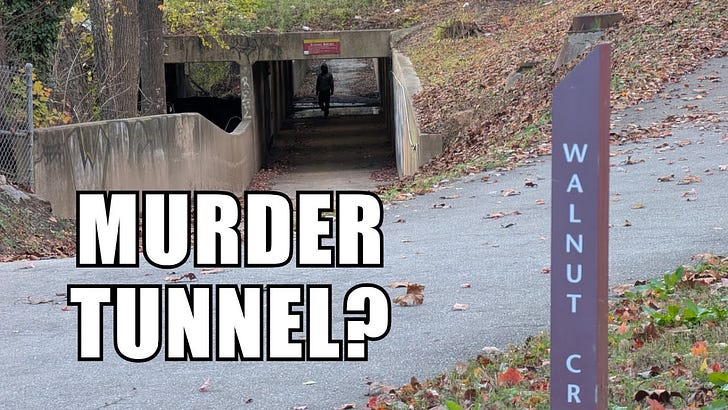
The incident bears some resemblance to the 2020 fatal stabbing of cyclist Chauncey “Chip” Depew on the Walnut Creek Trail in Raleigh near the intersection of I-40 and S. Saunders St., a location also frequented by the homeless:
Raleigh's most dangerous greenway? Woman "randomly" assaulted near location of cyclist's 2020 murder
Raleigh's Capital Area Greenway System, self-described as "a vibrant network of public trails and open spaces perfect for walking, cycling, or using a wheelchair or scooter."
However, while Durham Mayor Leonardo Williams acknowledged city has had complaints about “open fires” and “trash,” the police have released little information besides that the killing of Lyons “does not appear to be a random attack,” though they did not appear to acknowledge the reports of nearby homeless encampments or clarify whether the victim or the killer may have been among their inhabitants.
As reported by the News & Observer, radio traffic indicates the victim called the police at approximately 4:15 pm on Monday to report that he had been stabbed in the back, but dropped off the line and was not located by the police until half-an-hour had passed.
Users of the r/bullcity subreddit, usually ones to pooh-pooh and downvote any inkling of a suggestion that Durham is dangerous, appear to collectively agree that this is the one area of the city which is a serious problem and should be addressed:
“The gas station is a epicenter for drugs. Been known for 10 years+” - ForceAntique3229
“Lots of homeless folks. Many drug users, strung out, clustered in the wooded areas. And definitely occasional fighting. Not to mention that there’s trash everywhere. A known open sore that the city ignores.” - mcswagner
“The boots on the ground issue with that area is that there are many dark wooded areas along the ATT on both sides of F-Ville convenient for sleeping/smoking crack/shooting up.” - SeenInDurham
“My hunch is that it was probably someone from the encampment killing someone else in the encampment.” - Nervous-Emotion28
“Anyone who regularly travels the Tobacco Trail in Durham recognizes this area as the sketchiest part of the trail, really the only part that makes the trail sketchy. The city needs to resolve this. You can’t change the habits of those sketchy people but you can build tall fences and deterrents to keep the trail safer. They hang there on those makeshift spots because it’s been allowed for far too long.” - EatinSumGrapes
“There are tent encampments on both sides of ATT at this intersection. Last weekend I was biking with my kids along ATT towards the ballpark. That intersection was unhinged, even at 2pm in the afternoon on a Sunday. There were mentally ill folks yelling profanities at each other from the bus stop. Skirmishes between these same folks shoving each other. There was a line of folks by the trail, obvious drug users high out of their minds. There were fire pits by the trail side, still smoldering and the area reeked of marijuana.” - radarbot
A search for “American Tobacco Trail” on the forum reveals numerous personal accounts of incidents on this trail and this particular Fayetteville St. intersection:
“When I was riding the ATT every day, I was heading back North right as it was getting dark and had a group of people on the trail, by the bench just South of Fayetteville st spread out across the path in front of me to stop me...” - pbgod (2026)
“I used to ride and run there regularly and have only been threatened once, but if you are concerned, the Al Bueler trail is safer, but with much more limited parking.” - runs1note (2018)
“Tell that to my buddy who was jumped by 4 teens while jogging on ATC. Maybe it’s not generally a ‘problem’ but there have been a number of assaults on the trail.” - 5zepp (2018)
In terms of safety, I’ve had two incidents that have given me pause over the years. One was just north of Hillside High and the other a bit more north at Fayetteville. In the first one, I’d ridden my bike north on the trail to downtown without incident. As I was heading back, I noticed the trail was blocked numerous limbs that I’m pretty certain were dragged into place. As I slowed, some young men (or teens) emerged from the woods. I was able to bunny hop in one spot and keep riding, and called 9-1-1.
The second incident (at the Fayetteville crossing) happened so fast it’s kind of a blur. One guy jumped in front of me, trying to get me to stop or crash, and the other guy was running towards me. They were well older and perhaps homeless. I avoided crashing and was able to just keep going. Both incidents were midday during weekdays when the trail is not very crowded. I’ve avoided that section for 2-3 years now as a result.” - photog_in_nc (2024)“I love the ATT and travel it regularly, but the section between about Otis street and Cornwallis is a disaster. Trash everywhere and dangerous people lurking...People have tried for decades to keep the Fayetteville/E. Pilot street intersection clean to no avail.” - chambchan (2024)
“Solo females (or anyone, really) be careful on the American Tobacco Trail near Fayetteville St. crossing by the Food Lion/Chicken Hut.
...
On Jan 2 around noon I was running South on ATT and a kid/teen (maybe 13-14 years old) walking in the opposite direction turned around and started following me running behind me for about a mile. He started following me at the Fayetteville St intersection and stopped and turned around when the trail meets Riddle Rd. behind Hillside HS. It was super agitating but the kid looked so young, I felt more like I needed to educate him on why you don’t follow people (especially women) on the trail vs. feeling actually threatened.On Jan 3 around 3pm I was out on the trail and again I see this kid in the exact same area. Again, he is walking in the opposite direction of me, turns around, and begins jogging behind me. I couldn’t believe this was happening again and was thinking about what I wanted to do, when the kid comes sprinting up behind me, smacks my ass, and continued running up off the trail into a neighborhood (Atlantic St.)” - bullcityrungal (2024)
“A friend of mine was groped back in the summer. Apparently there was a groper going around because I later saw a news report about a guy (not a teen like in OP’s story) groping ladies on one of the trails. His modus operandi was to grope a woman, then flee on a bike. I wonder if they ever caught him. It seems to be a real problem...” - CFO_of_SOXL (2024)
“Heads up: crossing Fayetteville on the American Tobacco Trail and a sketchy dude in the woods yelled ahead to another sketchy dude who stepped from the woods into the center of the path as I crossed. He’s glaring at me from 10-20 yards out (dark pants, hood, black mask) straddling the dividing line…
…so I took off through the grass on instinct alone. I’ve biked cities for years, encountering harmless weirdos regularly, but this was the first time I encountered what truly felt like a dangerous situation. I was, thankfully, already too wide of him and had accelerated too quickly for him to make a move.” - deleted (2022)
A 2014 study funded by the left-wing Z. Smith Reynolds Foundation titled “Social Justice as it Pertains to Safety on the American Tobacco Trail” attempted to blame the perception of safety on the trail on disproportionate media attention and “implicit racial bias,” but was nonetheless forced to admit that this Fayetteville St. intersection was an “exception” to the overall relative safety of the trail as compared to surrounding high-crime neighborhoods.

In addition the pseudonymous reports on social media, reporting in the mainstream media includes police confirmation of numerous similar incidents on the trail in the area over the past decades:
Three incidents of indecent exposure on the trail within two month, including one by “a man standing on the trail near Fayetteville and Pilots streets” who exposed himself to two sisters (WRAL, 2007)
17-year-old student at nearby Hillside High School charged with two assaults in which he punched a cyclist and a pedestrian, the latter of whom he robbed of a cellphone and an iPod (WRAL, 2014)
Three incidents of indecent exposure on the stretch north of the intersection in a two month period, one 23-year-old man charged with exposing himself to a woman and two children, while another perpetrator exposed himself to two different women (News & Observer, 2017)
In each of these incidents, the perpetrator was identified as a black male, suggesting that the attempt by the study to refute those who may “associat[e] African American men...with higher crime rates and a lack of safety” is not based in fact.
Use of property tax “loophole” by for-profit landlords skyrockets
Affordable Housing Tax Loophole Threatens to Drain Local Government Budgets in NC - NC Newsline
Affordable Housing Property Tax Exemption Loophole ‘the Biggest Threat’ to Wake County Revenue - WRAL
State Loophole Lets Raleigh-Area Companies Cut $745 Million from Wake County Property Rolls - WRAL
A property tax exemption intended for non-profits providing low-cost housing is being used by for-profit owners to avoid paying millions of dollars a year in property taxes.
In 2010, the North Carolina General Assembly adopted a property tax exemption for property owned by “a nonprofit organization providing housing for individuals or families with low or moderate incomes.” (NCGS § 105-278.6(a)(8))
However, in 2013, the North Carolina Court of Appeals ruled that a property which was 99.9% owned by a for-profit organization and 0.01% owned by a non-profit could still receive the exemption by taking into account factors such as
the entity’s control of the venture’s operations;
the entity’s status as trustee of LLC property;
the possibility of future increased actual ownership interest; and
the intent of the participating parties
A decade later, the amount of property covered by such exemptions is increasing rapidly, with a 50% year-over-year increase between 2023-24 and 2024-25, according to a House Select Committee on Property Tax Reduction and Reform presentation with data from the NC Department of Revenue.

According to the presentation, Wake and Durham are among the counties with the highest per capita amount of property tax valuation exempted under this category.
This exemption was named the “biggest threat to the revenue stream of the county” by the Wake County Tax Administrator at a Wake County Board of Commissioners meeting in February, revealing that up to “94% of all the multi-family units in Wake County” could make use of the exemption by pushing the boundaries of the appellate ruling with creative ownership structure.
The number of properties actually exempted under this section in Wake County jumped from 69 in 2021 to 137 in 2025, which represented a nearly 10x increase in the value of the property exempted from $289 million to $2.2 billion. At the current base property tax rate of .5171, this exemption represents over $11 million in lost revenue for the county itself, with $6 million lost by the City of Raleigh according to Mayor Janet Cowell.
One factor that makes this a particular issue for Wake County is that the Housing & Urban Development’s definition for low and moderate income is based on 80% of the median income; according to the US Census Bureau, the county’s median household income of $105,768 is nearly 50% higher than the state median of $72,388.
An effort to modify the law to close this loophole is in the works at the legistlator, with Rep. Erin Paré (R-37) of southwestern Wake County who chairs the house select committee promising a “fix” to the “growing and costly abuse” under this exemption in a post last month.
Is the Triangle ripe for an Islamic terrorist attack?
A Senegalese Muslim wearing “Property of Allah” and an Iranian flag on his shirts shoots up a bar in Austin, killing three and injuring fifteen more.
A pair of second-generation immigrants with parents who naturalized from Afghanistan and Turkey declare their allegiance to the Islamic State and attempt to outdo the Boston Marathon bombing by throwing improvised explosive devices at an anti-Islam demonstration in New York City.
A Sierra Leonean who had previously been convicted of providing support to the Islamic State shouts “Allahu Akbar” before attacking a classroom filled full of Reserve Officer Training Corps students at Old Dominion University in an attempt to replicate the deadly 2009 Fort Hood shooting, but only managed to murder one instructor before being killed by his targets.
A Lebanese Muslim drives his explosive-laden vehicle into a synagogue near Detroit.
This cluster of terrorist attacks has occurred in just the past several weeks.
But could the Triangle or elsewhere in North Carolina be the target of the next Islamic terrorist?
While one of these attacks involved the terrorists driving multiple states to conduct a terror attack in America’s largest city, the other three targeted locations in or near the communities in which these Muslim immigrants settled.
Given the large Muslim population with parallel demographics to these attackers and the following history of Islamic terrorism involving the counties of Durham, Johnston, Orange, and Wake, the possibility cannot be ruled out.
Terrorism and Jihad in the Triangle
Islamic Radicalization in North Carolina - International Institute for Counter-Terrorism
In the 1980s, a small Baptist college in Murfreesboro had become a pipeline for Muslim students seeking an American education, with a dean of admissions recruiting internationally in the Middle East with the offer of enrollment without any test of English proficiency.
One such student was Khalid Sheikh Mohammed, a Pakistani who was already a member of the Muslim Brotherhood when he enrolled at Chowan College in 1984 amid a class which was primarily composed of Middle Eastern students. According to a biography of Mohammed, he was attracted to the area “because of North Carolina’s politically active Muslim community, numbering as many as fourteen thousand across the state,” including “Muslim Brotherhood and Salafi activity” in “Murfreesboro, Raleigh and Greensboro.”
Mohammed transferred to and graduated from North Carolina A&T State University in Greensboro with a bachelor’s degree in mechanical engineering, which he shortly put to use planning terror attacks including the 1993 World Trade Center bombing (carried out in part by Mohammed’s nephew), as well as masterminding the September 11 attacks eight years later.
Five years after the 9/11 attacks, UNC-Chapel Hill alumnus Mohammed Reza Taheri-azar attempted to follow in the footsteps of al-Qaeda hijacker Mohamed Atta to “avenge the deaths of Muslims worldwide” by driving his SUV onto his alma mater’s campus in March 2006 and striking nine pedestrians, all of whom survived. Taheri-azar was born in Iran, but became a naturalized citizen after being brought to the states at the age of two and raised in Charlotte.
Three years later, in 2009, the FBI busted an Islamic terrorist conspiracy involving eight North Carolina residents in operation “Triangle Terror Takedown” which “began in 2005 with a tip from someone in the Muslim community,” according to the FBI.
The ring included Daniel Patrick “Saifullah” Boyd, a white American who converted to Islam after his mother remarried a Muslim, two of his sons, and another five conspirators who appear to be first or second generation immigrants to America from countries such as Bosnia, Kosovo, and Pakistan.
The group were accused of aiding foreign terrorists, as well as planning an attack on the Marine base at Quantico; seven members were convicted of federal charges and received sentences ranging from eight to forty-five years imprisonment, while the eighth terrorist named in the conspiracy was out of the country, and was eventually killed in a drone strike.
Although sometimes referred to as the “Raleigh jihad group,” where some of the members lived, Boyd and his sons were residents of Willow Spring, and Boyd had opened a halal market in Garner which he had used for recruitment, according to the FBI: “The talk at the market was often about fighting jihad and how, in their belief, fighting jihad was an obligation.”
(The jihadists also reportedly “practiced with the weapons and developed their military tactics on private property in rural Caswell County.”)
Boyd was heavily involved in the Muslim community across the Triangle, including at least two mosques (Jaamat Ibad ar-Rahman in Durham and the Islamic Center of Raleigh) which he either left or was asked to leave due to his radicalism.
Boyd’s business partner in his jihadi-involved Blackstone Market was Sheikh Abdenasser Zouhri, who has been involved as an Islamic religious leader at JIAR as well as the Islamic Center of Morrisville.
Over the following years, the feds have made a handful of arrests related to Islamic jihad/terrorism related to the Triangle area:
2013, Cary, Pakistani immigrant Basit Javed Sheikh attempted to join al-Qaeda front in Syria
2014, Raleigh, African-Americans Akba Jihad Jordan and Avin Marsalis Brown attempted to join jihadis in Yemen/Syria
2015, York (SC), 16-year-old Syrian-origin Zakaryia Abdin planned with NC-based Muslim militant to rob Raleigh gun store and attack military members in North Carolina
2017, York (SC), Abdin attempted to fly to Jordan to join ISIS after being released on parole
2017, Cary, white American Garrett Asger Grimsley planned attack on non-Muslims
2024, Durham, white American Alexander Justin White planned to travel to Morocco to join ISIS:

Analysis: religious freedom vs immigration
Although this violent Islamic extremism is not limited to Muslim immigrants and their children, the above examples show that they make up the preponderance of these incidents, with the Muslim community playing a known role in the jihadi conspiracy of American converts like Daniel Boyd, while the radicalization of other converts is unknown.
As covered in a recent article on the Muslim Brotherhood-linked Islamic schools funded by school choice vouchers, the vast majority of the rise of Islam and its radical fringe in America is a result of immigration policy, not of Americans exercising the “freedom of religion:”
In analyzing whether it is “truly American” to defend the cultural jihad of Islam in the West, one may turn to founders like Thomas Jefferson, who successfully advocated for a religious freedom bill in Virginia which he noted would encompass the “Mahometan” and the “Hindoo.”
However, in practice, the founders had no intent to let the Muslim or Hindu peoples take root in America, as one of the laws passed by the First Congress was the Naturalization Act of 1790 which forbid American citizenship to every foreigner who was not a “free white person...of good character.”
This restriction lasted in some form until 1952, when the McCarran-Walter Act removed the racial language while maintaining national/regional quotas with the intent to “preserve the sociological and cultural balance of the United States.” (European countries received 94.41% of the quotas, with 41.22% going to the UK, 16.28% to Germany, and 11.20% to Ireland).
The national-origins quotas were abolished with the Hart-Celler Act in 1965, truly throwing the doors of the nation open to the world outside of the predominantly Christian peoples of Europe.
The ongoing record-high immigration wave has not only reshaped the demographics of America, bringing the population of white Americans down from 85% in 1965 to 57.5% in the 2020 census, it has also exploded the Muslim population from approximately 100,000-150,000 in 1965 to an estimated 4.5 million in 2020.
The number of mosques in the United States has steadily grown along with the influx of Muslims, more than doubling in the years since the 9/11 attacks from 1,209 in 2000 to nearly 2,769 in 2020 according to the US Mosque Survey.
Voucher-funded Islamic schools linked to Muslim Brotherhood terrorist organizations

An expanding Islamic school with campuses in Durham and North Raleigh has ties to the radical Muslim Brotherhood, according to a report by the RAIR Foundation.