Long Carolina, a Forgotten Earl, and the Regulation
A brief history of the colonial counties of the Triangle
Counties have a long history in our state, predating even the “North” in North Carolina.
Prior to the prominence of incorporated municipalities and modern representative redistricting, the counties played a more prominent role in civil administration, law enforcement, as well as the apportionment of representatives in the legislative bodies. (The latter role remains as the “whole county” provision in the North Carolina Constitution, though its implementation is currently crippled by federal mandate.)
As the settlers expanded and developed the colony westward, counties were created, divided, and reshaped, whose names mark a patchwork of history ranging from English nobility to Civil War-era leaders.
For this article, we will briefly review the history of the counties making up what is now the Triangle area leading up to and during the Revolutionary War, touching on subjects like the Lords Proprietor, the War of Regulation, and a British politician so hated by our founding fathers that his name was erased from the state’s map.
The Long Counties
When the first charters for the Province of Carolina were issued by Charles I in 1629 and Charles II in 1663, the western border was “soe fare as the Continent extends itselfe” in the former and “as far as the south seas” in the latter.
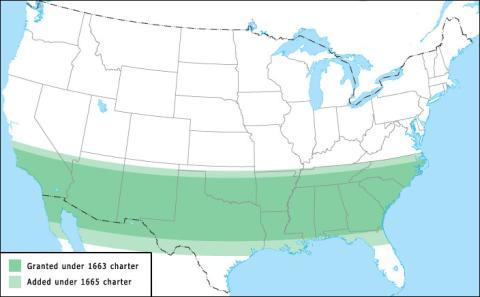
Why is this relevant to our discussion?
In the mid 1700s, when our first counties of Granville, Johnston, and later Orange were split off from the earlier easterly counties of Craven, Edgecombe, and Bladen, the western boundaries of these counties were not set, meaning that they extended on paper to the western edge of the territory claimed by North Carolina, which ended at the Pacific Ocean.
In practice, these early indefinite counties only extended so far as the British settlers could exert effective dominion, but technically, these counties could claim to have briefly encompassed a strip of America in which the cities of Nashville, Knoxville, Santa Fe, and Las Vegas have since been constructed.
1746
In 1746, the area now known as the Triangle reached the level of population that North Carolina legislature passed laws creating Granville and Johnston, the sixteenth and seventeenth counties in the colony out of what was then Edgecomb and Craven respectively.
At the time, settlers in the southern part of the area could find themselves over a hundred miles from the Craven County seat in New Bern, while those in the northern part had a shorter but still significant trek to the county courthouse in Enfield, which is now in Halifax County.
I. Whereas Craven County is now become so very Extensive that many of the Inhabitants thereof live very remote from New Bern Town, where the Court for the said County is held, whereby a great many Difficulties and Hardships arise to the upper Inhabitants thereof, not only in attending their Ordinary Business in the said Court, but also being compelled to serve as Jurymen, and oftentimes as Evidences, at the said Court...
An Act for Erecting the Upper Part of Craven County into a County and Parish, and for Appointing a Place for Building a Court House, Prison and Stocks in the Said County. (State Records of North Carolina, Volume 23, p. 248)
Johnston County
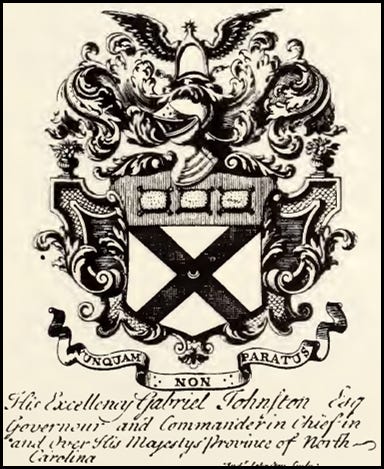
Johnston County was named after the governor at the time, Gabriel Johnston, Esq., a Scotsman who was sent over to serve as the 6th royal governor from 1734 until his death in 1754. Johnston was instrumental in encouraging the settlement of his fellow Scots in the Cape Fear region, with whom he was perceived to side with in disputes with the inhabitants of the northern counties.
Johnston’s term in office was also marked by conflict with the colonists and their representatives in the House of Burgesses over quit-rents, a type of land tax, with 500 men rose in arms to free a man in Edenton who had reportedly been jailed for refusing to pay. (Johnston’s gubernatorial salary, which was intended to have been payed out of these taxes, was £13,462 in arrears at the time of his death, or approximately $3.8 million in 2026 dollars).
While Johnston had been dead for 25 years by the time of the Revolution, his nephew Samuel Johnston, Jr. would become a supporter of independence, serving in the House of Burgesses, the first four provincial congresses, the North Carolina Senate, and the Continental Congress, as well as being elected as the sixth governor of the State of North Carolina; Gabriel Johnston’s grandson, William Johnston Dawson, also served the state as a member of the state legislature as well as two terms as a US Congressman.
The western border of Johnston County would be capped with the creation of Orange County in 1752, and would further be pared down to provide all or nearly all the area for the counties of what are now Wake, Wayne, Greene, as well as significant portions of Wilson and Lenoir.
Granville County
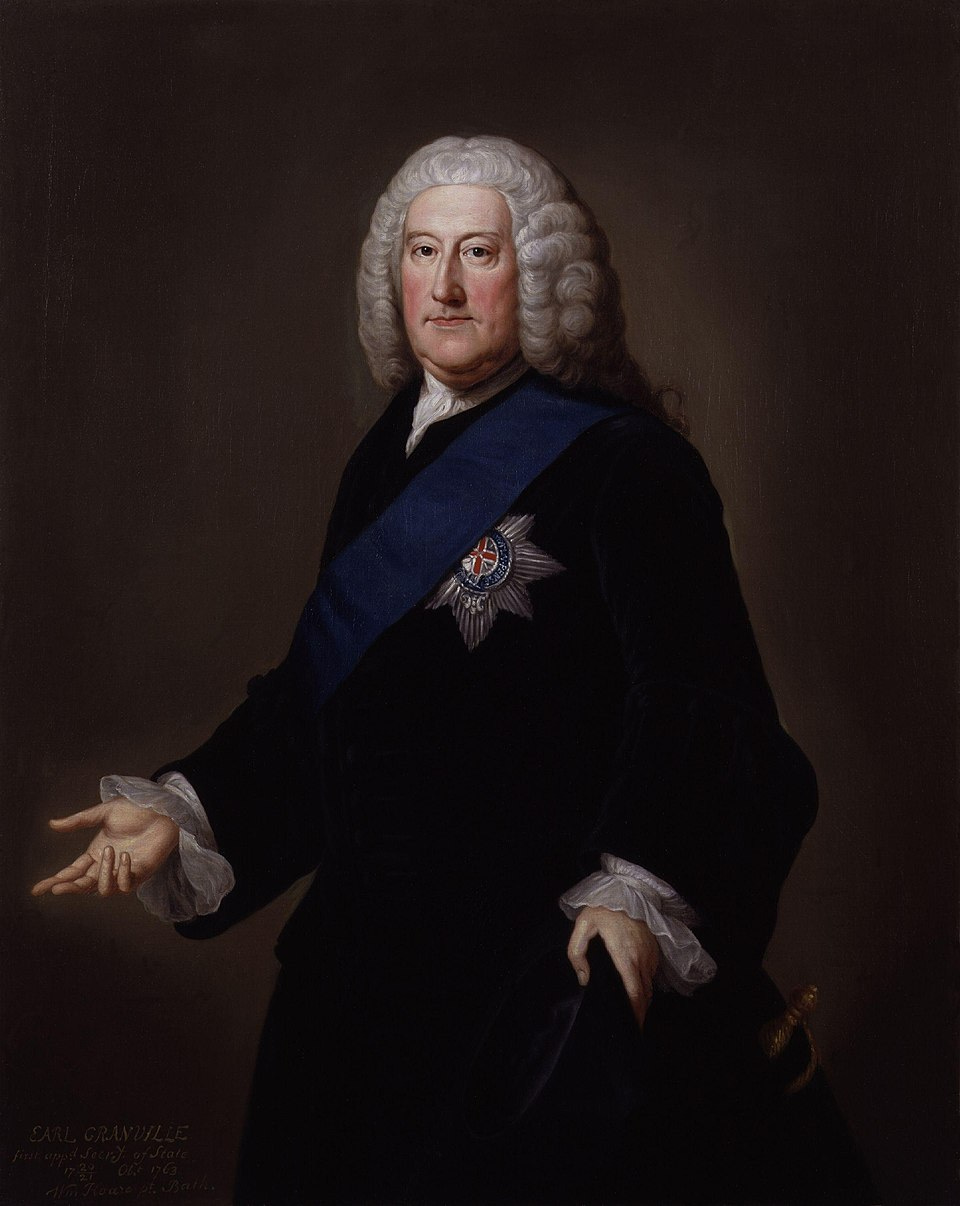
John Carteret, 2nd Earl Granville and namesake of Granville County, played a significant role in the development of early North Carolina, despite never setting foot in the new world. Granville inherited a one-eight share of the Province of Carolina originally given to his great-grandfather Sir George Carteret as a reward for his support for the crown during the English Civil War.
Although the owners of the other seven shares in the province sold their claims to the crown in 1729, Granville had declined to do so, instead ceding his right to govern the colony as it was transformed into the two royal colonies of North and South Carolina; Granville was eventually assigned his share as the Granville District, a massive strip of North Carolina which stretched across the province from the Virginia border to a line which can still be seen on a map as the southern boundary of Chatham, Randolph, Davidson, and Rowan.
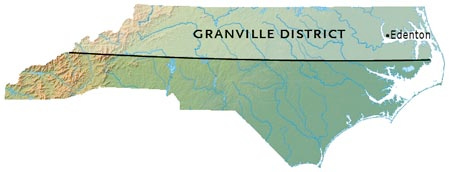

The Granville District complicated the politics of the colony, as the royal government was still responsible for the area, while the revenue went to Granville. The earl’s agents caused further problems by a lack of punctiliousness in keeping records and executing grants, leading to unclear property titles. Granville died in 1763, and his North Carolina lands were confiscated by the State of North Carolina in 1777 as a supporter of the British Crown.
Granville served various positions in the British government, including Ambassador to Sweden, Secretary of State for the Southern Department, Lord Lieutenant of Ireland, Secretary of State for the Northern Department, and Lord President of the Council.
The Granville County of 1746 was not the first Granville County in the Carolinas; in 1684, a Carteret County was established in the south of what is now South Carolina, which was renamed to Granville County in 1708, which existed until the South Carolina government eliminated the county system in 1768. (Based on the dates, this Carteret County would have been named after Granville’s grandfather or his late great-grandfather, while the Granville would have been after his mother or her late father.)
In addition, the naming of Carteret County in eastern North Carolina in 1722 was named after either Granville or his great-grandfather, the original proprietor, while the naming of Elizabethtown in Bladen County is sometimes attributed to being in honor of the proprietor’s wife, Lady Elizabeth Carteret.
Like Johnston County, the western frontier border of Granville County would be ceded to Orange County in 1752/1753, while the eastern half of the county would form Bute County in 1764 and a portion of Vance County in 1881.
1752
Orange County
Orange County was established in 1752 from Granville, Johnston, and Bladen after German immigrants began “flocking” to the area, as characterized by Gov. Johnston.
The specific origin of the county’s name is unclear, it was either named for William V, Prince of Orange, who was the four-year-old grandson of then-King George II, or for his distant relative William III, a prior Prince of Orange who deposed his uncle James II in the “Glorious Revolution” to rule as joint monarch of England, Scotland, and Ireland with his wife Mary II.
After William and Mary died without children, and her successor Anne having no children who survived to adulthood, the Parliament of England chose the distantly related House of Hanover as the successors to the throne, passing up at least 50 closer relatives who had the misfortune of being Catholic to crown George I as King of the newly united Great Britain and Ireland.
George I’s granddaughter Anne married William IV, Prince of Orange, a distant cousin of William III who inherited the title through a different line of succession. Anne gave birth to William V in 1748, thus introducing to confusion as to which German this county in a British colony was named after.
Either way, the name Orange comes from the Principality of Orange in what is now Southeastern France. Although it may be spelled and pronounced the same way, the ancient Celtic etymology of the location is in fact entirely distinct from that of the color, which comes from a Dravidian root referring to the fruit.
By the time of the Revolution, Orange County boasted the only proper “town” in the area, which was founded in 1754 and shuffled through several names before landing on Hillsborough in 1766 after Wills Hill, Earl of Hillsborough, who had been President of the Board of Trade and Plantations. Hillsborough was significant enough to achieve its own representative in the House of Burgesses in 1771, in addition to the two representatives from the county, a status only held by eight other towns at the time.


1764
Bute County
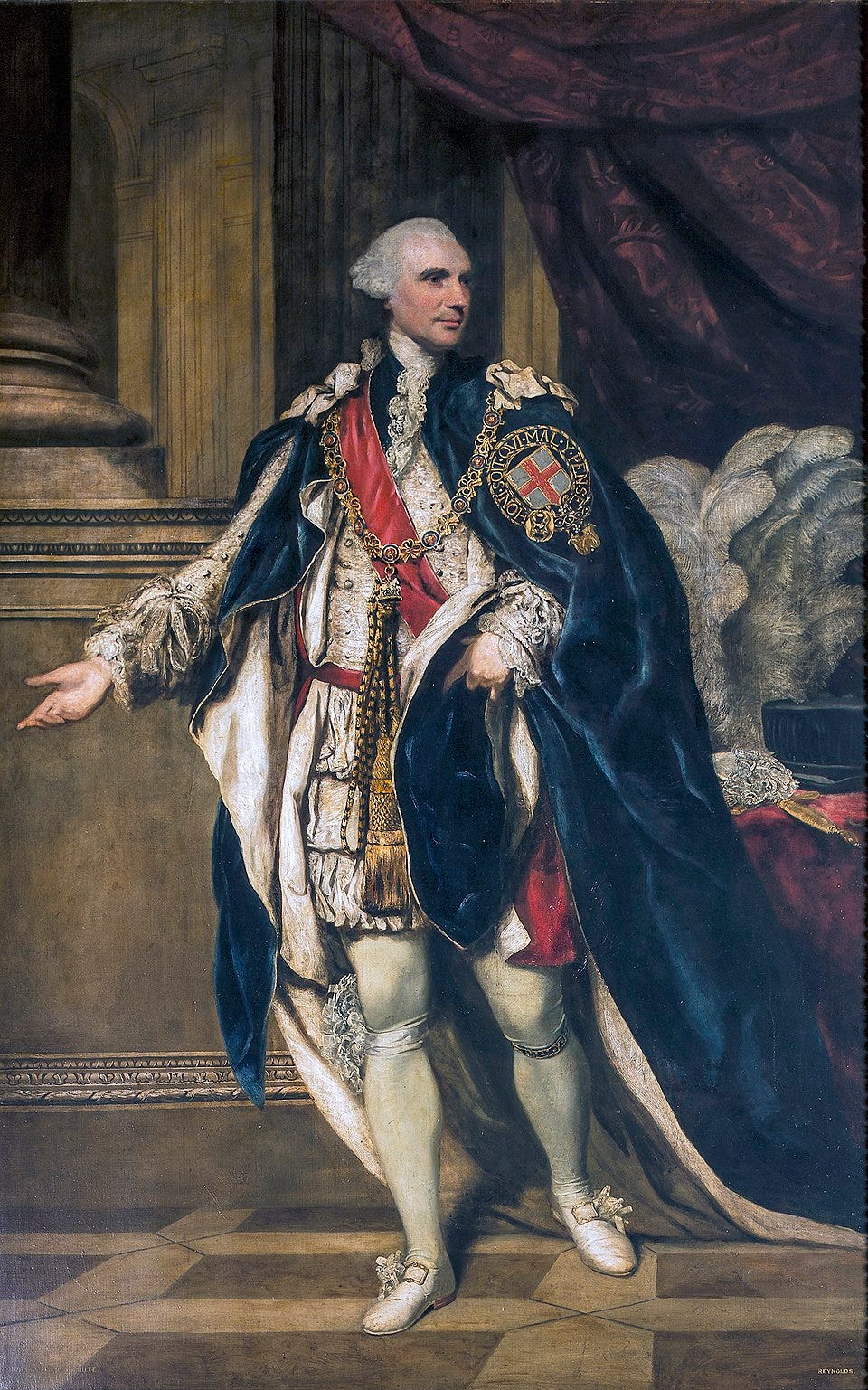
In 1764, the eastern half of Granville County was split off to form Bute County, named after John Stuart, 3rd Earl of Bute.
Bute had served as the tutor for the future George III, and maneuvered himself into the position of Prime Minister in 1762, two years after his former pupil’s coronation.
However, Bute’s term was short lived, resigning in 1763 due to criticism over his signing of the Treaty of Paris to end the French and Indian War, which was perceived as being too favorable towards Britain’s enemies of France and Spain.
Nonetheless, in his short term as prime minister, Bute managed to set the colonies on the path towards Revolution through the post-war financial policy he initiated, which included additional taxes in America to cover the costs of the war as well as fund the British military presence in America. Bute also instituted a highly unpopular cider tax resulting in riots in England and solidifying his association with high taxes in the mind of the public.
Although Bute was officially out of power when the offensive Stamp Act was passed in 1765, he was perceived as still wielding influence in the British government as an advisor to the King, and he was permanently associated in the eyes of the colonists with the policies which drove the wedge between the colonies and royal government, ultimately leading to war.
For instance, protesters in Boston hung a boot with a green-painted sole under the town’s Liberty Tree as a physical pun in reference to both Bute and his successor as prime minister, George Grenville; Bute was also hung or burned in effigy in Boston, Wilmington, and Halifax (Nova Scotia). In fact, the use of the term “jackboot” as a symbol and metaphor for tyranny appears to date back to Bute’s association with unpopular authoritarian policies, with the term and the symbol being used at the time in protest both in England and America.
Although many names from the earlier colonial period still remain to this day, the newly formed state government chose to discard the name of Bute in 1779 when splitting the county horizontally, with Warren County selected for for the northern half in honor of Dr. Joseph Warren, a leading Massachusetts patriot who had fallen at the Battle of Bunker Hill in 1775, and Franklin County for the southern half as one of the first of many American counties, towns, cities, and even an attempted state named after Benjamin Franklin, who was then on his way to serve as Minister to France.
1771
The Regulation
In the mid-1760s, an antigovernmental movement began escalating in North Carolina, variously known as the Regulation, the War of Regulation, the Regulator Movement, etc.
As students of the second amendment may know, the term “regulation” or “regulator” did not carry the same connotation of bureaucracy or governmental restriction with which they have become associated with, but rather to bring things into a state of order. At the time, the term “Regulator” also had over a century of use specifically as referring to someone redressing or reforming government abuse.
The Regulators in North Carolina are often traced back to the Nutbush Address, given by Granville County teacher George Sims from the area now known as Williamsboro in Vance County.
The specific grievances in the address were the abuse of the poor by a corrupt system of debt, lawyers, and the court. The Regulators also complained of unfair taxation, corrupt officials, land speculation, and a shortage of the hard currency required to pay taxes and debts.
The movement was noted to be the strongest in the western counties of Granville and Orange, as well as Anson to the southwest.
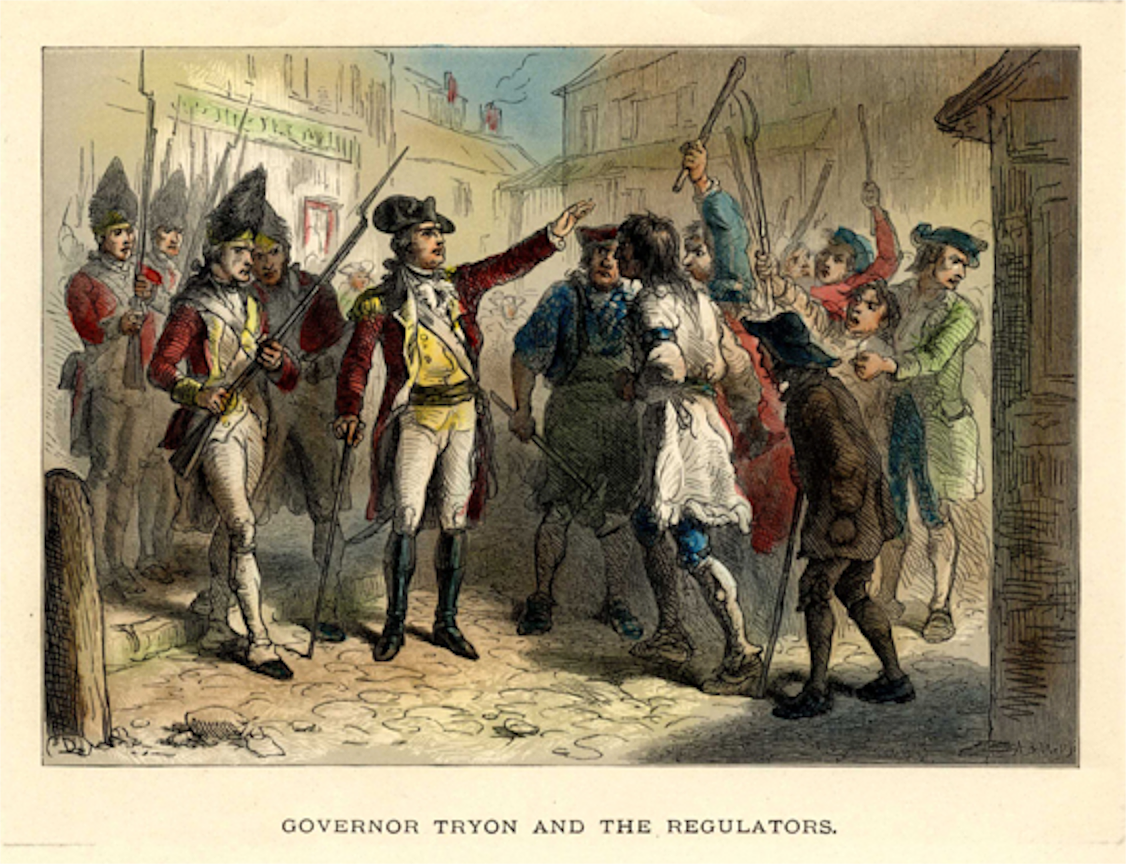
The Regulation came to a head in Hillsborough, where Regulators stormed, vandalized, and desecrated the county courthouse in 1770, along with the destruction of private businesses and homes, and the beating of lawyers including Edmund Fanning, an official holding multiple positions who had attracted their particular ire.
The rebellion ended the following May, when ~2,000 Regulators gathered in Western Orange County (now Alamance) to face off against ~1,000 troops gathered by Governor William Tryon.
Although greatly outnumbered, by all accounts, Tryon’s forces included ~150 professional British soldiers and eight small cannons, and decisively prevailed over the Regulators at the Battle of Alamance, inflicting hundreds of casualties and capturing many of the movement’s leaders, six of whom were swiftly tried and hanged in Hillsborough.
A battle involving thousands of combatants may seem relatively small compared to more modern conflict, but this represented a rather large portion of the state’s free adult male population.
In the months leading up to this battle, the legislature creating four new counties, with Chatham being created wholly from Orange County, while Wake and Guilford each included pieces of Orange County in their formation.
It would be extraordinary if the timing was coincidental; according to the website of the Joel Lane Museum House, the purpose was to allow the legislature to “exercise more control” by breaking up Orange County, which was then the largest county by population, as well as grant more representation. (Each new county was allocated two representatives in the House of Burgesses, while several of the oldest counties had five.)
The bills for the creation of the counties also included a list of hand-picked commissioners with which the government could fill its allies, such as Fanning, who was named as commissioner for the newly created Chatham County.
Chatham County
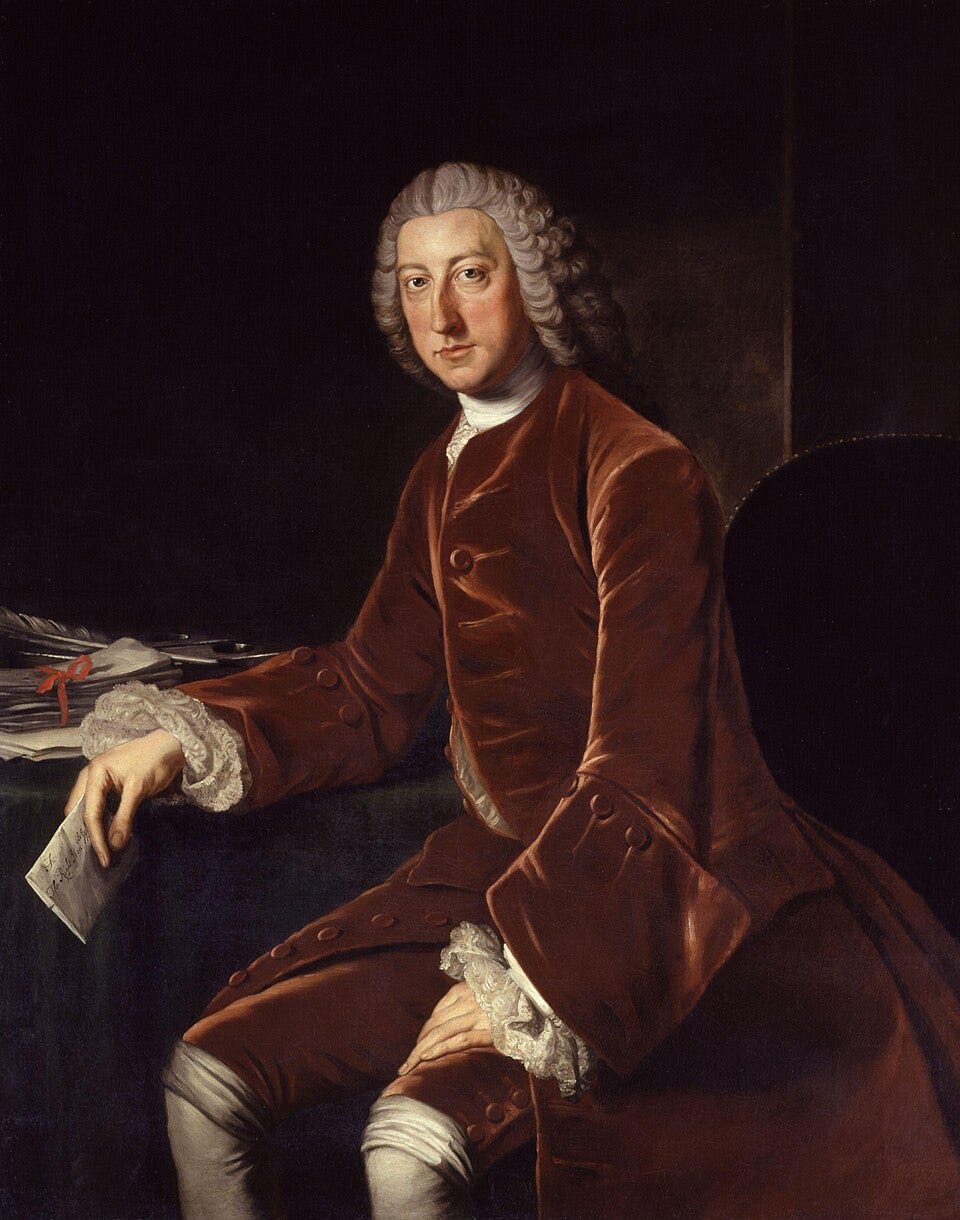
Chatham County was named after William Pitt, 1st Earl of Chatham an English statesman known for his oratory in the House of Commons for over thirty years, which he had recently put to use defending America and championing the repeal of the Stamp Act on the grounds that it was unconstitutional to impose taxes on the colonies. In 1775, Chatham proposed a “Provisional Act” which attempted to mediate the worsening relationship between the colonies and the motherland by acknowledging the right of the colonies to levy their own taxes, while asserting certain other powers of the King and Parliament.
Chatham had been instrumental in directing the French and Indian War as a member of the British cabinet until 1761, and is credited with the strategy which secured a British victory. He officially returned as prime minister from 1766 to 1768, but his leadership was stymied by ill health.
After resigning, he continued to argue for a sympathetic approach to the American colonies and against continuing to antagonize them, yet opposed American independence as a strong imperialist. Chatham died in 1778 after collapsing while speaking on the topic of America in the House of Lords.
Wake County
Wake County, on the other hand, was named in honor of the wife of the governor, Margaret Wake Tryon.
Tryon’s spending habits had been among the complaints of the Regulators, including that he convinced the legislature to raise taxes to fund the construction of Tryon Palace in New Bern as the official residence of the North Carolina governor.
Shortly after successfully putting down the Regulation, and only a year after completing his controversial house, on the public dime, Tryon left with his wife for New York, where he had been appointed royal governor.
Tryon attempted to defend the crown’s interest against the growing patriot sentiment in New York, ultimately taking a military command after New York was placed under martial law, leading raids to burn and plunder patriot towns in Connecticut.
As for Margaret Wake Tryon herself, she was known for being more interested in topics of conversation reserved for men, such as government, military fortifications, and military strategy, and demanded to be referred to as “Your Excellency,” an honorific granted to her husband as governor.