
"They are destroying the planet:" Was Hedingham mass shooting motivated by environmentalism?
After shooting himself in the head, Austin Thompson does not remember why he shot up his neighborhood in Raleigh. But he left a note.
Despite their statistical rarity, an active shooter incident weighs heavier on the public consciousness than an equivalent amount of individual homicides.
To adapt a phrase widely misattributed to Joseph Stalin: the 2022 mass shooting in the Hedingham neighborhood of Raleigh was a tragedy, the other 44 homicides in the same city that same year are a statistic.
The astonishing nature of these tragedies lend them to becoming catalysts for political or cultural change in a manner that the public attention given to individual homicides rarely rises to, with notable exceptions such as the murder of Iryna Zarutska or the assassination of Charlie Kirk.
For example, just days after Dylann Roof slaughtered nine black churchgoers in Charleston in 2016, mainstream media outlets were drawing national attention to the Confederate battle flag which had been flying over the South Carolina State House for over fifty years, and three weeks later the state government had drafted and enacted legislation to have it removed.
In the days after the Hedingham shooting, the numerous politicians offering their thoughts and prayers were speckled with Democrats such as David Price who took the opportunity to call for anti-gun legislation.
But what happens when a mass shooter leaves evidence of a motive which neither the investigating law enforcement agencies, nor the prosecuting attorneys, nor the defense, nor the mainstream media appear to have an interest in making the public aware of?
In the case of the Covenant School shooting in Nashville in 2023, when a transgender-identifying female murdered three students and three staff members at a Presbyterian elementary school, it took years of legal battles, law enforcement leaks, and official dithering before releasing material from the shooter revealing that she had explicitly chosen her target due to her hatred of religion and hatred of white people.
For Hendingham shooter Austin Thompson, it took over three years to get the slightest inkling of the fact that the 15-year-old had left a note describing his reasoning for the slaughter of his brother and his neighbors as hatred of humanity for “destroying the planet,” a fact which the public has generally not been apprised of.
The Raleigh Police Department was in possession of the note since the day of the shooting, yet declined to make the public aware of its existence, instead reporting that the motive was “unknown.”
Given that the shooter kinetically removed his own memory of the day, it is left as an exercise for the reader to come to their own interpretation of the sincerity of his stated motivation, in light of the following facts.
Shooting
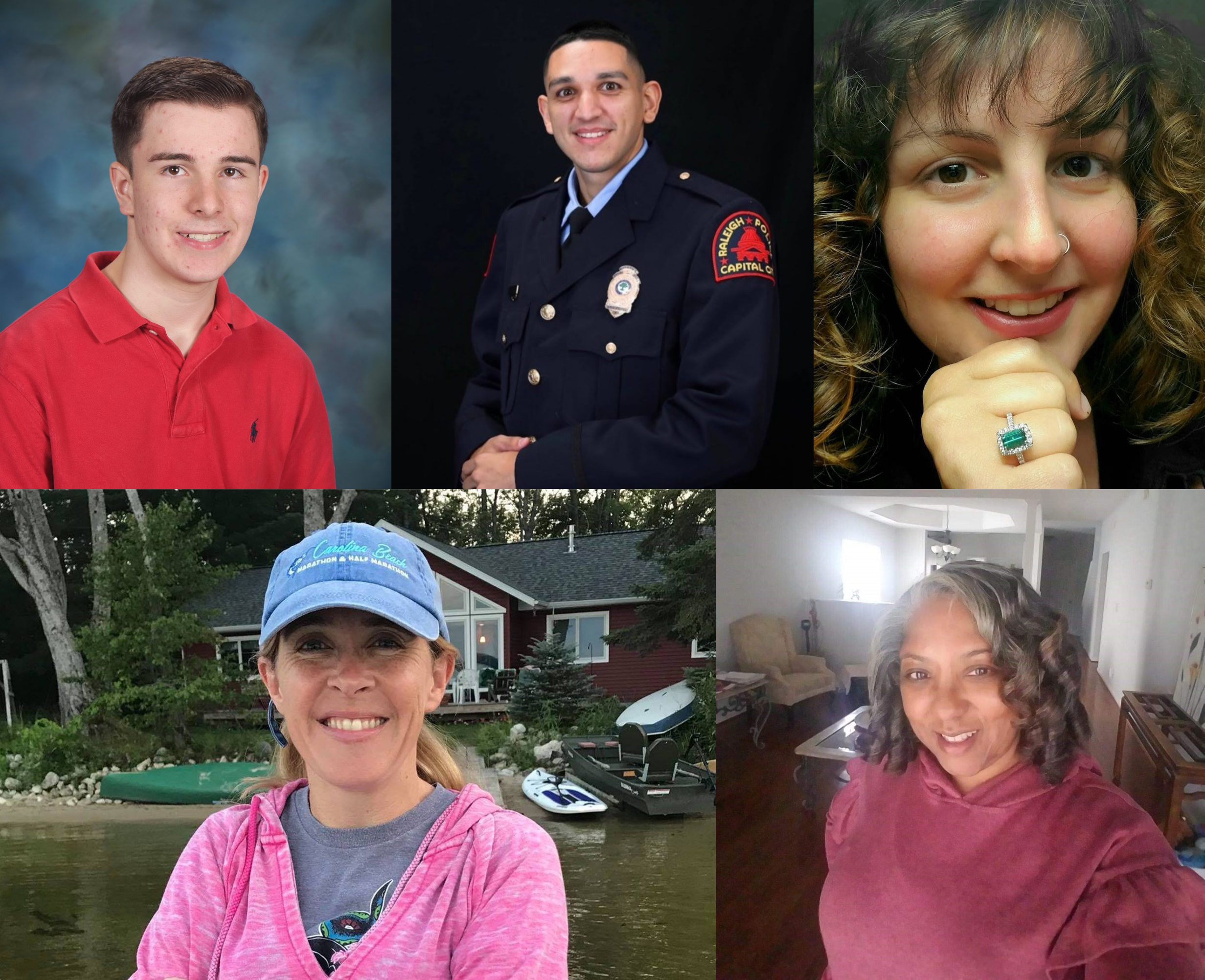
On October 13, 2022, 15-year-old Austin Thompson began his killing spree at his home in the Hedingham neighborhood in east Raleigh with the killing of his older brother James, whom he shot in the head with a .22 rifle and stabbed dozens of times with a knife.
Almost an hour later at around 5 pm, he left his home clothed in camouflage and armed with a shotgun and a handgun to continue his rampage outdoors.
Thompson proceeded to shoot two neighbors outside a nearby home (one of whom survived with serious injuries), an off-duty officer of the Raleigh Police Department in his personal vehicle on his way to work, and two victims who were out on the Neuse River Greenway Trail.
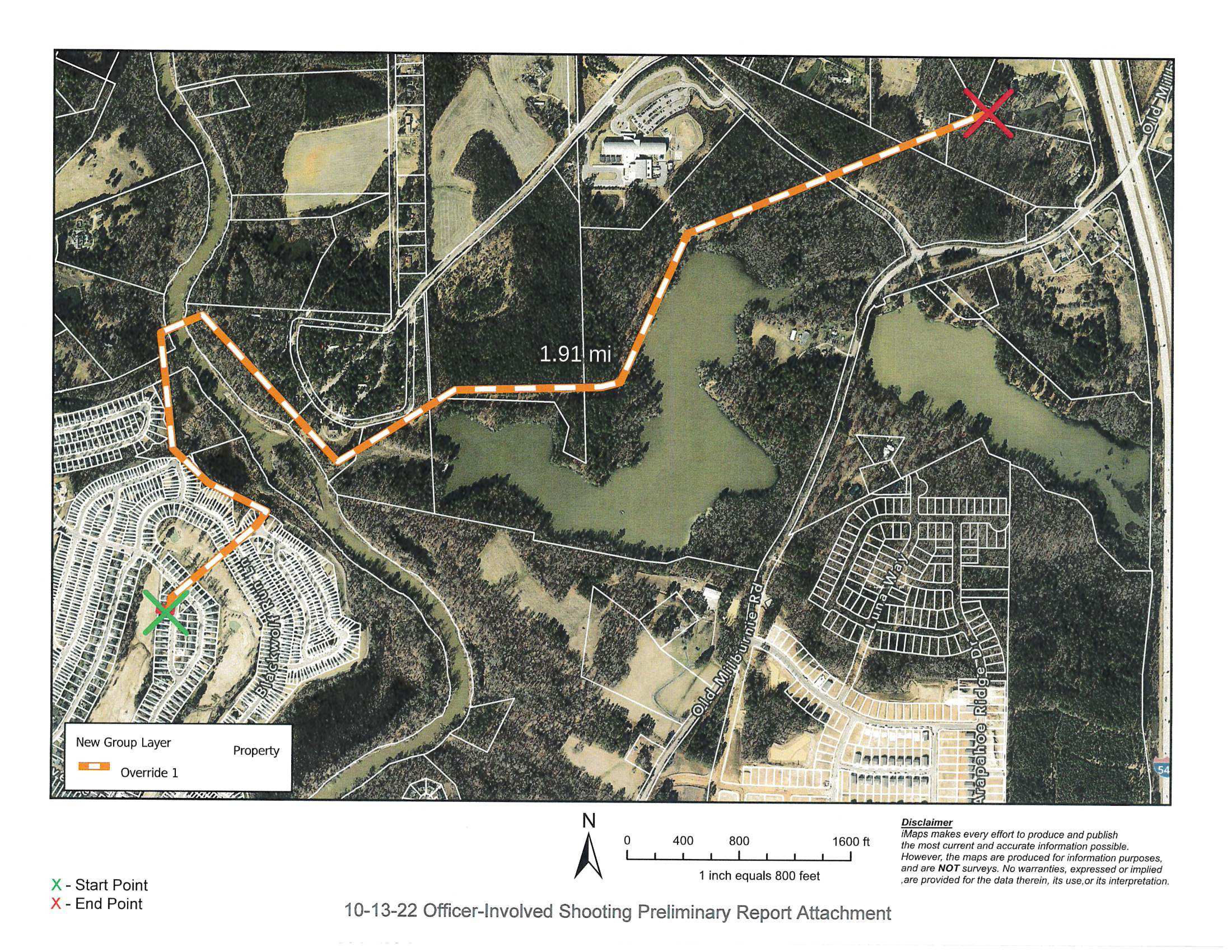
Police began arriving on the scene ten minutes after the first 911 call was received, but it wasn’t until over an hour later with additional citizen sightings and the deployment of K-9 officers that Thompson was tracked down near I-540 across the Neuse River over a mile from his first murders.
However, as officers were searching the area, Thompson ambushed them with multiple shots from cover, striking one of the approaching officers in the knee, inflicting a career-ending injury.
The officers returned fire, but when Raleigh SWAT officers carefully approached his hiding spot three hours later, they found Thompson incapacitated from a single self-inflicted gunshot wound to the head.
Thompson survived, and was charged as an adult with the murder of the five victims who did not.
Coverup?
The day after the attack, then-RPD Chief Estella Patterson told the media that no motive was known, which was repeated in the five-day preliminary report put out by the department.
“The collective motive for these attacks is still unknown,” the report read. “Based on information currently available, there does not appear to be any connection between the victims that were shot by the suspect prior to his encounter with the police other than they lived in the same neighborhood.”
However, as testimony by an RPD detective who investigated the scene would reveal over three years later, a note was found on the same day of the shooting which began with: “The reason I did this is...”
The note appears to have been first referenced in a motion by Thompson’s defense team in December ahead of trial asking to “restrict argument, speculation, or opinion of motive of racial bias or gender bias,” arguing there was “no meaningful evidence” to support the “salacious accusation” made along those lines in a civil lawsuit filed over the shooting.
According to Thompson’s lawyers, the affidavits relied on to support the claims that Thompson had “used racial slurs” and “pick[ed] on women” were dubious, with one affidavit being contradicted by the affiant’s statements to police, and with another affiant “disavow[ing]” claims attributed to him, explaining that the affidavit had been drafted by the plaintiff’s lawyers and he had not actually read it before signing.
(No evidence related to these sensational allegations appears to have been entered as testimony at Thompson’s sentencing.)
Sentencing
Thompson’s case never made it to trial. Instead, less than two weeks before it was slated to begin, Thompson pleaded guilty to the entire set of charges he was facing: five counts of first degree murder, two counts of attempted murder, two counts of assault with a deadly weapon with intent to kill inflicting serious injury, and one count of assault with a firearm on a law enforcement officer.
In a notice of intent to plead guilty filed by the defense, Thompson’s lawyers wrote that Thompson “cannot explain why he committed this shooting” due to the self-inflicted brain injury at the end of his rampage, but nonetheless admitted his guilt in order to “save the community and the victims from as much additional infliction of trauma as possible.”
The guilty plea allowed the court to skip directly to a multi-day sentencing hearing, in which the prosecution and the defense presented evidence to sway the judge between the two sentencing options legally available for a defendant convicted of murder who was under the age of eighteen at the time of the crime: life with parole, or life without parole.
The prosecution’s case in the hearing included survivors and the family of the victims describing the impact of the crimes, RPD officers laying out the facts revealed in the investigation, and an FBI profiler testifying about the psychology of mass shooters.
The defense’s evidence included testimony regarding the permanent effects of Thompson’s brain damage, his behavior in detention, and the possible rare “depersonalization” side effects of minocycline, an acne medication which Thompson was on at the time of the murders.
Ultimately, the judge sided with the prosecution’s argument for stricter punishment and sentenced Thompson to the maximum possible: life in prison without parole.
The Note
Among the evidence brought to light during the trial was the full copy of the note left in his bedroom by Thompson after the killing his brother, revealing that while he claimed to have no “goal,” he did have a “reason” for the massacre.
“The reason I did this is because I hate humans,” the note read. “They are destroying the planet/earth.”
According to the note, Thompson began with the murder of his brother so he wouldn’t “get in [his] way,” while he left a torn off corner of the note outside the bathroom where he had left his brother’s corpse, warning his parents not to look.
Thompson denied being bullied, insane, or suicidal, instead explaining his lack of care for his expected impending end as that “death is like sleep” and that “it is going to happen anyway.”
Front:
_ Austin 4:25 PM 10/13/2022
The reason I did this is because
I hate humans they are destroying theplanet/earth
Killed him at 4:20 about C5 minutes off
maybe
he kept breathing so I stabbed him
stopped breathing about 10-15 minutes laterI don’t have a goal
I am not suicidal
death is like sleep that’s why I
don’t care if I dieI was never buillied or anything
by dad
I dont like you mom
every other family member is
good
thanks juan and deanglu
for taking me huntingI dont want to die but it is going
to happen anyway
Back:
you were the best dad
I was never bullied in school either
(cops)I killed james because he would get
in my wayI killed james with a
subsonic .22 I stole from
cabelasI have no
regreatsIm not mental
either I was
sane when I did
this


Radical Environmentalism?
If one didn’t dive into the details of the day-by-day reporting by mainstream media, one might be forgiven for not being aware of the self-proclaimed environmentalist motivation.
For instance, while a News & Observer article titled “Why did a 15-year-old open fire on Hedingham? The question that haunts Raleigh” includes an image of one side of the note, but zero quotes from the note, and no discussion of or elaboration on Thompson’s stated motivation of humans “destroying the planet.”
This is reflective of the lines of argumentation made by the prosecution and defense during the sentencing hearing, both of which referenced the note while giving little credibility to the “reason” written left by Thompson and showing little curiosity in questioning witnesses who may have had knowledge of his true level of passion for the cause, while numerous witnesses were asked questions about Thompson playing violent video games, which were not referenced in his confession note.
“The defendant’s parents have asked from day one, ‘why would he do this?’” questioned Wake County Assistant District Attorney Patrick Latour in the prosecution’s closing statement. “The reality is we will probably never know why he did this.”
(It is not clear when, if ever, Thompson’s parents were made aware of the contents of the note. Thompson’s mother and father both testified that they were not aware of any red flags in their son’s behavior prior to the shooting, but do not appear to have been asked any questions about his interest in environmentalism.)
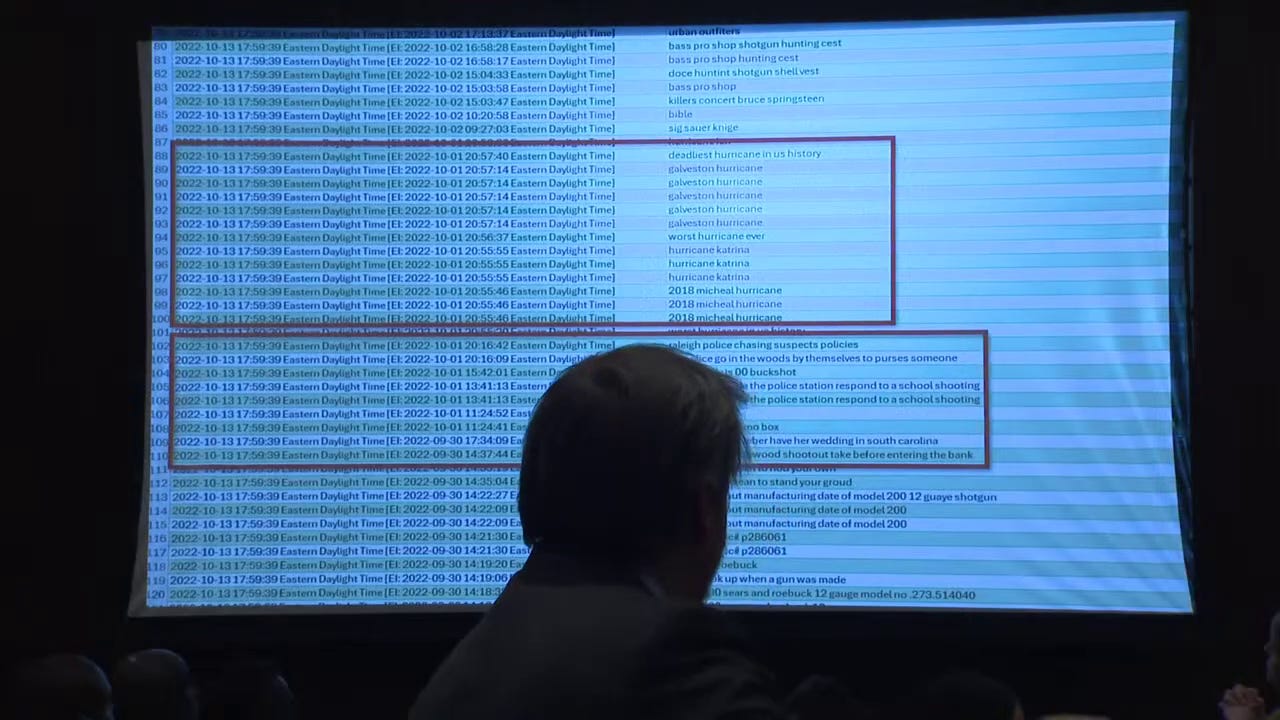
Instead, Latour put much more emphasis on the material found in 30,000 entries in Thompson’s search history analyzed by investigators, including numerous searches related to previous mass shootings, legal consequences for his crimes, and other related queries.
Latour’s closing did bring up the environmentalist motivation in the context of discrediting the testimony of the defense’s psychiatrist witness Dr. George Corbin, who had testified that the note “makes no sense” and that he had not seen evidence of Thompson’s preoccupation with the subject, but admitted that it had been a motivation for previous “enviro-terrorists.”
Amid the search history mentioned almost as an aside by Latour was a series of queries on hurricanes twelve days before the shooting: “When you go back through, there’s a lot of searches about hurricanes.”
“I would submit to you he’s a hunter,” Latour continued. “Hunters tend to care about conservation and the environment. It’s not out of the realm of possibility that that’s something that he latched on to.”
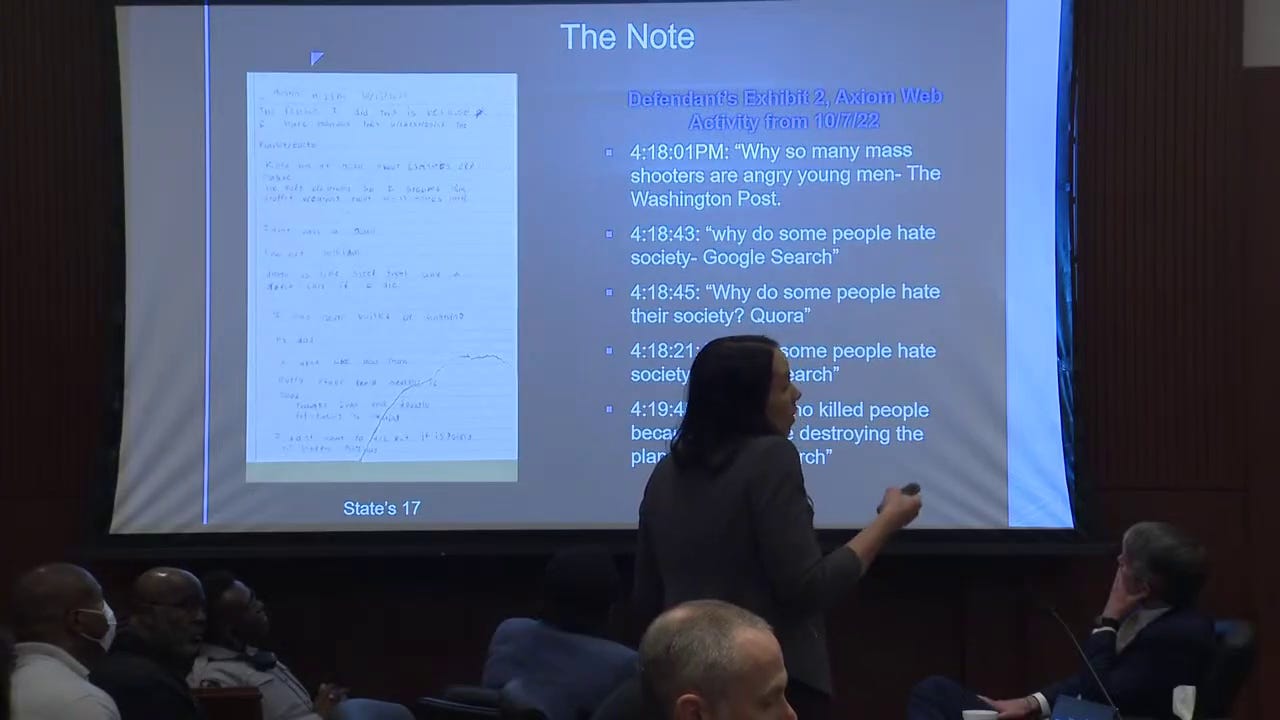
The defense’s closing arguments, on the other hand, attempted to downplay Thompson’s interest in researching crime, massacres, torture, etc. as only a small portion among his tens of thousands of searches, but presented the following web activity by Thompson seven days before the shooting in which he searched for other environmentally motivated killers after a Washington Post article on “angry young men” becoming mass shooters:
4:18:01PM: “Why so many mass shooters are angry young men- The Washington Post.”
4:18:43: “why do some people hate society- Google Search”
4:18:45: “Why do some people hate their society? Quora”
4:18:21: “why do some people hate society- Google Search”
4:19:48: “person who killed people because they were destroying the planet- Google Search”
A “Green” School System
Among the witnesses in the sentencing were six of Thompson’s prior teachers, four of whom were from Knightdale High School where Thompson was enrolled at the time of the shooting, including his Earth Science teacher from the year prior.
These teachers were asked dozens of questions related to Thompson’s penchant for playing video games in class, yet neither the prosecution nor the defense appear to have asked the teachers a single question about what Thompson may have been involved with or taught about in school regarding environmentalism, anthropogenic climate change, conservation, etc.
However, publicly available material shows an emphasis on “green” education at both KHS as well as the Wake County Public School System which it is part of, with the district being awarded a “District Sustainability Award” in 2021 from the U.S. Department of Education’s Green Ribbon Schools program, which cited in part opportunities for WCPSS teachers to participate in professional development opportunities “creat[ing] learning units that focus on such topics as water quality, reducing the carbon footprint, and relating scientific research to personal and global health.”
The award cites the Wake Green Schools Partnership, where “teachers, administrators and community partners” are “greening school campuses and increasing students’ environmental literacy all across Wake County.”
The WCPSS application for the award specifically singled out a KHS “career academy” program as “focus[ing] on green career pathways” as part of the district’s “Effective Environmental and Sustainability Education.”
The Knightdale Academy of Environmental Studies is one of the “personalized small learning communities within Knightdale High” whose mission has been described as being to “prepare students to make knowledgeable career choices through work-based experiences and applications of current environmental issues.”
WCPSS was also lauded for the fact that “student experiences are influenced by regional organizations that are innovative, environmentally sustainable, and focused on scientific research.”
An example of such an organization could be the Triangle Land Conservancy, which partners with KSH in a fellowship program to rectify the “lack of racial diversity in environmental organizations.” TLC’s website also reveals that the land trust sees radical leftist activism as being essential to it’s mission of land conservation, which is characterized as having “historically perpetuated systemic racism,” and that radical leftist activism is necessary in “turning the tide” against the “water of white dominant culture:” “We believe that our goal of sharing land conservation benefits with every single person in the Triangle cannot be reached without actively working to end racism.”
Thanks very much for the work you’re doing.
Every parent should be concerned about the extremism their children are being taught in the Public School system